
Bilateral Roadmap and Summary of New Agreements between Canada and China
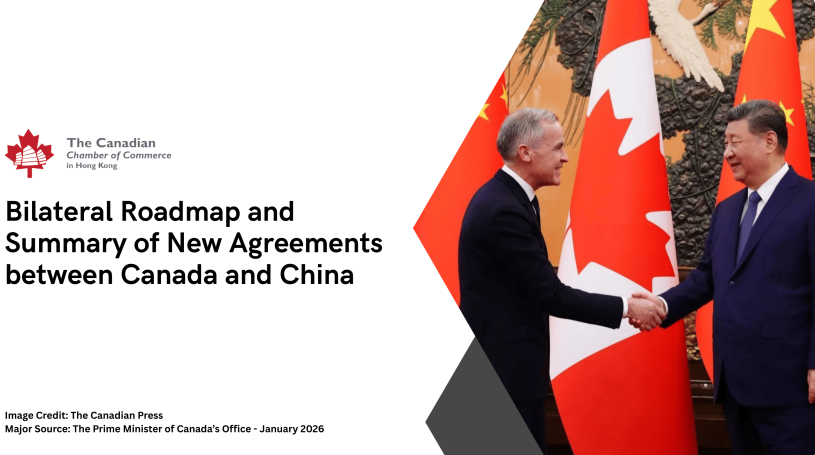
The landscape of Canada-China relations has taken a significant and positive step forward. Following the official visit of Prime Minister Mark Carney to Beijing in January 2026, the governments of Canada and China have released a substantial package of agreements and a collaborative roadmap aimed at revitalizing economic and trade ties.
This breakthrough is not just diplomatic rhetoric; it translates into concrete, actionable outcomes that directly benefit Canadian exporters, investors, and businesses looking to engage with the world's second-largest economy. The Canadian Chamber of Commerce in Hong Kong is pleased to share a summary document and detailed roadmap.
[Download the Full Document Below]
Wins for Canadian Businesses
The visit yielded several market access improvements and policy shifts, including:
- Travel Eased: A commitment to visa-free access for Canadian passport holders for stays up to 30 days.
- Electric Vehicles: A dramatic reduction in tariffs on eligible Canadian EV imports, from 100% to 6.1%, with an annual quota.
- Agriculture Reopened: Critical news for Western Canadian farmers—canola tariffs slashed from 84% to 15%, reopening a vital export market. Tariffs have also been removed on Canadian lobster, snow crab, and dried peas.
- Financial Cooperation Renewed: A renewed and substantial RMB/CAD currency swap agreement (RMB 200 billion) to facilitate smoother trade and investment.
Collectively, these measures are poised to unlock nearly $3 billion in export opportunities for Canadian workers and businesses.
A Strategic Roadmap for the Future
Beyond these immediate gains, the two nations have committed to a structured "Canada-China Economic and Trade Cooperation Roadmap." This framework is designed to provide stability and a clear channel for dialogue, focusing on:
- Strengthening Institutional Dialogue: Revitalizing the high-level Joint Economic and Trade Commission (JETC) to promoting economic and trade cooperation and resolving economic and trade differences between the two countries.
- Advancing Green Trade: Promoting cooperation in clean energy, technology, and sustainable wood construction.
- Enhancing Investment: Both sides have explicitly welcomed investments in key sectors like energy, agriculture, technology, and consumer products.
- Improving Agrifood Cooperation: Establishing protocols to resolve technical barriers and ensure food security through renewed agreements.
- Facilitating Personnel Exchanges: Encouraging more business travel, tourism, and direct flights between the two countries.
What This Means for Our Members
For Canadian companies in Hong Kong and the wider region, this development is a powerful signal:
- Reduced Barriers: Lower tariffs and clarified rules mean improved competitiveness for Canadian goods.
- New Opportunities: Sectors like EVs, agri-food, clean tech, LNG, and financial services are highlighted for growth.
- Stable Framework: The renewed dialogue mechanisms reduce regulatory uncertainty and provide a forum to address future challenges.
We encourage you to review the attached document in detail to understand how your sector may be impacted.
